Real ID

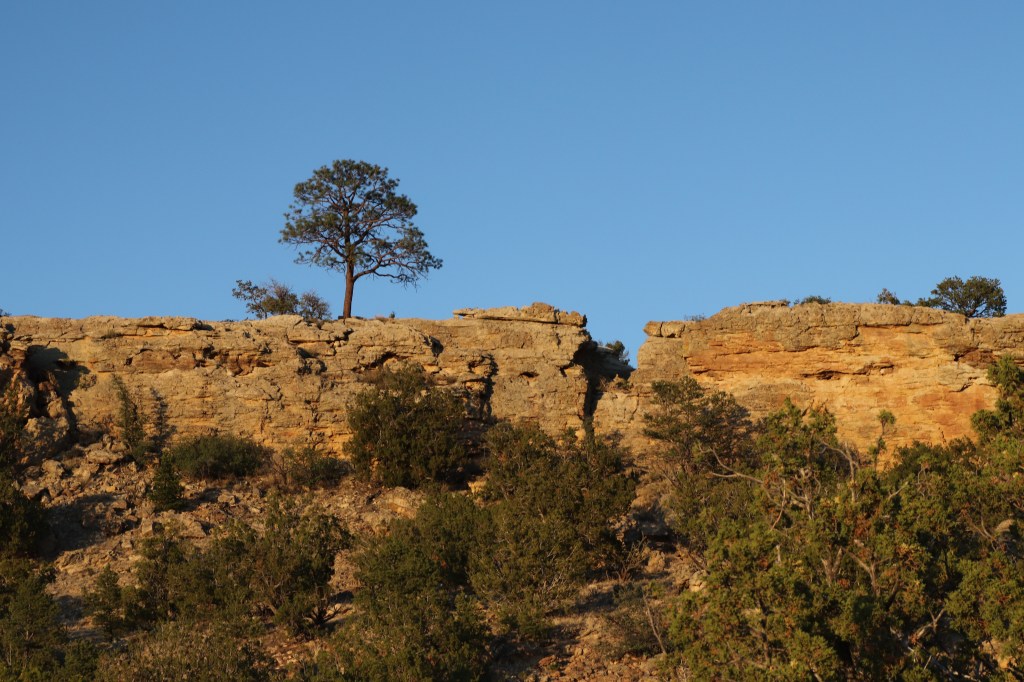
Image shows a lone piñon tree atop a golden-brown sandstone bluff with cloudless sky behind it. Smaller junipers dot the foreground.

The tree stood lookout. It was no protector, no stern, armed guard challenging all comers. Friend or foe? It didn’t judge.

It just stood, tall and alone, on the sandstone bluff overlooking the campground. Standing still, silent, it spoke of change. It pointed out the nuances of sky and wind, interpreted their meaning anew with every shifting cloud. It heralded the present. It did not want you to miss any savor of shape or color, light or shadow, the passage of time, the hum of eternity behind it.

Image shows the tree with a half-circle of puffy, white cloud rising from behind the bluff. The cloud is like a nimbus haloing the tree.

It never looked the same for ten minutes running. A different backdrop gave it new impact every time you saw it. Yet it never changed. It was only, always, ever, eloquently itself.

Image shows the nimbus cloud, now well above the bluff, looming over the tree to the right. A new cloud is rising to take its place.

It is the feature of the landscape I remember more than any other. My fellow campers remarked on it with affection and even awe. It stood so tall in a place of salience, an exclamation point in a landscape of dots.

Because of this tree, I couldn’t take time for granted. It made the world too intriguing in the now. “This moment is new and will never come again,” it said. “Look. Look!”

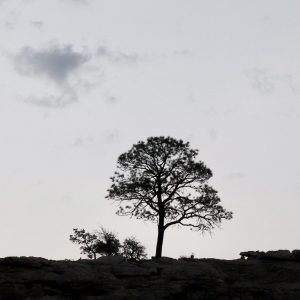
Image shows the tree at dawn, silhouetted against a sky halfway between nighttime and morning blue. A few pale pink wisps of cloud surround it. In the upper right, a tiny sliver of moon shines.

What part of you stays the same, and what changes when your backdrop alters? When you stand in different lights? Who are you really?

And how does the word you speak in the world change in different contexts?
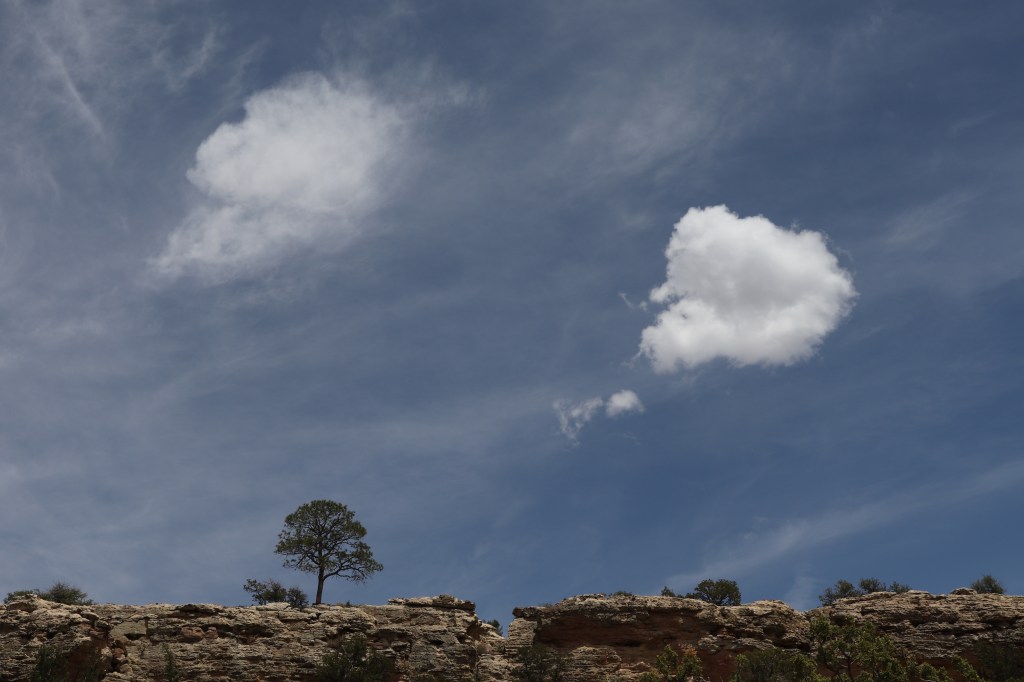
Image shows the tree amid a few wispy clouds at midday. Above and to the right, a smaller and larger puff of cloud seem to emerge from the tree like a thought balloon.

Living nomadically has made me wonder that anew, but the question of identity has plagued me for a while. We all have images of ourselves and who we are, but I have come to distrust identities that are contingent on circumstances—that can be taken from you when circumstances change. Health, ability, employment, relationships, geography, communities—all those things can change, most of them without our say-so.

We are also given identities without our say-so. Income, gender, physical ability, race, ethnicity, appearance, sexuality, and more all play a part in forming who the world thinks we are. What a productivity-driven culture thinks of me for being disabled, for example, for living nomadically, being middle-aged, or female, or single—relatively little of it jives with truth. But it is still hard not to fall for the distorted image reflected back to us, to separate ourselves from those partial truths to see clearly.

Image shows the tree at midday under a graying sky. The light is harsh and flat, and the tree and bluff both look washed out. Their vibrancy and warmth are gone.

Maybe the quest for identity—who am I really?—is the wrong quest, an endeavor to root ourselves in sand, which cannot nourish or anchor us, rather than soil or stone. Maybe it is wiser to root ourselves in the depths of what we value. Not in the self-image of being people who value certain things, but in the values themselves. Being. Gratitude. Wholeness. The behaviors that grow from them.

Image shows the tree at dawn, silhouetted against a translucent sky that almost shines. Wispy clouds are just beginning to reflect sunlight.

Maybe the point is to find your place of salience. To be so deeply rooted there that you can stand tall and herald this moment’s truth as it shines around you. “Look!” you say.

Look.
Crux

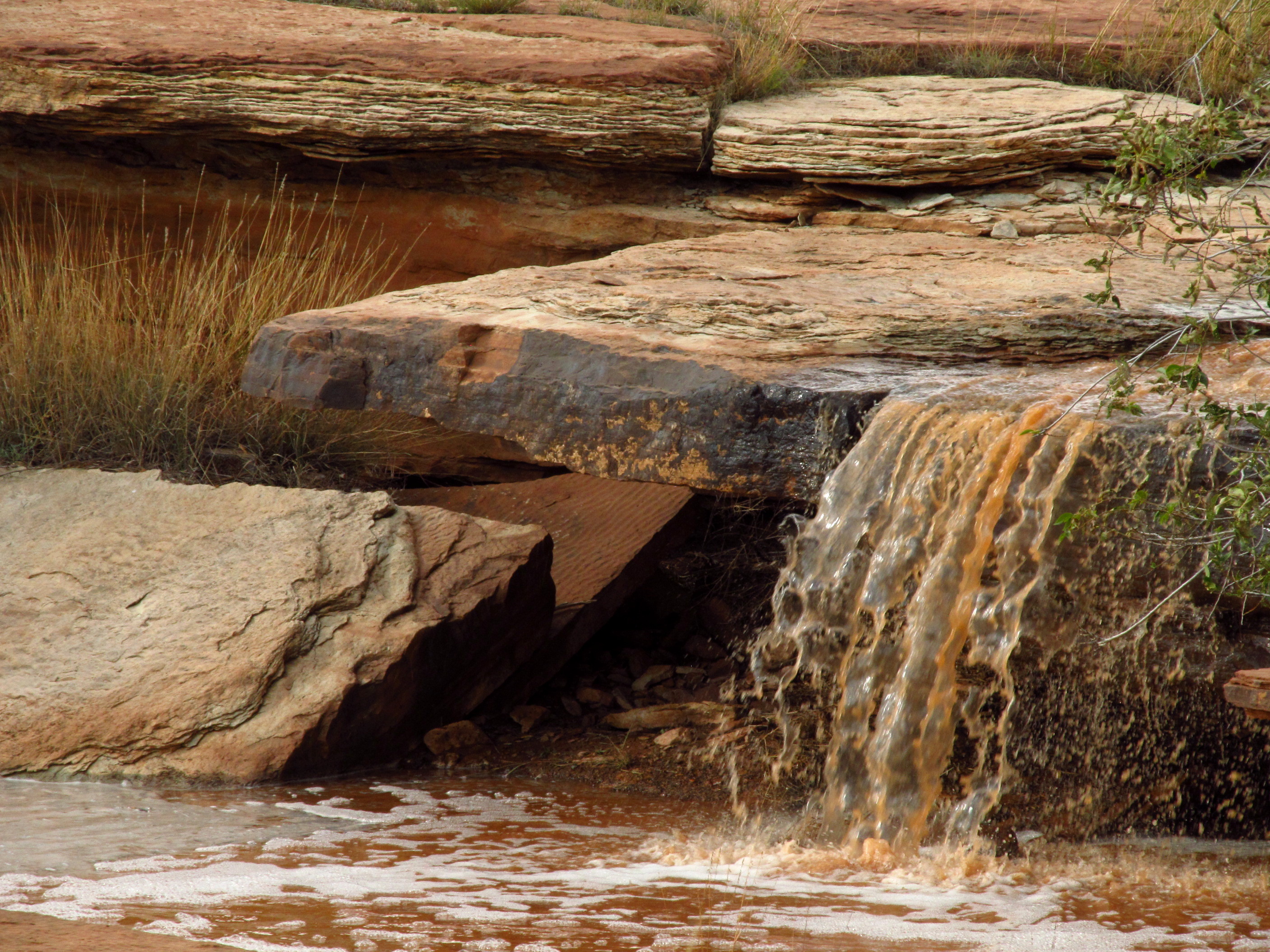
Think of the slow trickles of change: water dripping on sandstone. The sun arcing between horizons. The moral arc of the universe bending. Little squabbles getting louder, little silences stretching longer. The nagging ache tugging at your attention. The sapling inching up and out, year by year.

img_1140-2
Water. Sandstone.

And then the onrush—of change, awakening, realization: the sudden sum total of incremental movement. The stone gives way, and waters rush through the gap. The calendar flips (where did the time go?). An old paradigm crumbles, and you wake up to new, fairer laws; divorce; chemo. Hatchlings peep from a nest in the tree high overhead.

The onrush is the stuff of drama. By that I don’t mean emotion—I mean of stage and screen, the dramatic arts. A story, enacted around a moment of crisis, catastrophe, or awakening, when you look up and know the world will never be the same. Drama— serious or comic—comes from that turning point and the question, “Now what will you do?”

The themes of turning are archetypal. Love. Betrayal. Loss. Wonder. Overcoming. The speed or forcefulness of the action has little correlation to the depth of the crisis, the strength of the awakening. The same human can be reached as deeply by a touch as by a tsunami. A car chase, earthquake, or explosion could just as easily be a lifted eyebrow, a gasp, a turned page, a quiet resolution.

Or even a walk through a garden.

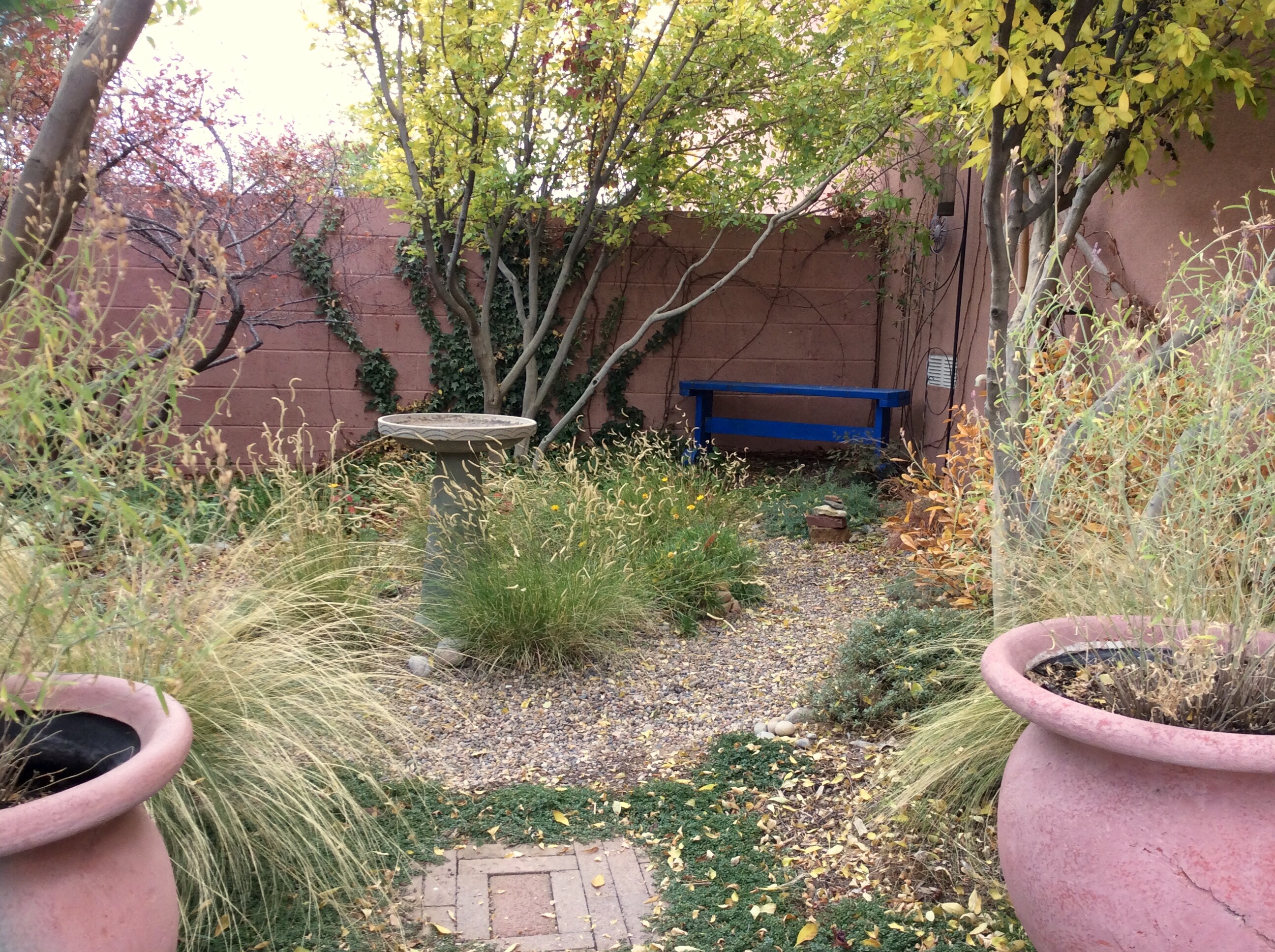
The view toward Civilization, November 2016

A garden tells a story around primal themes: civilization and wilderness, safety and adventure. My own garden, as tiny as it is, journeys from indoor ease to the patio’s domestication to a Western “wild” land beyond.

I’m not particularly good at garden design. I cannot envision a “look” of particular plants with heights and colors and bloom seasons all carefully coordinated. But I can picture a mood, an ambiance, and use it to craft a tale.

Lately I have resorted to something simple: naming the garden beds. I used to name them things like “that one bed” and “that other bed.” The garden did tell a story, but more the kind one hears from eager eight-year-olds, with lots of “um-um-um”‘s and tangents and no coherent plot, but plenty of bonus super-heroes. And trains. Endearing, but more because you love the eight-year-old than because the story hangs together.

Focusing the names has helped me to focus the story. (A rough draft of it, at least.) The names themselves are not romantic. They’re embarrassing enough that I never thought I’d put them into print:  the Hot Bed of Intrigue, the Bowl of Sunshine, the Wayside Picnic Area. But they provide the discipline I need when I’m pruning or planting or wandering a nursery.

The Threshold, the Bowl of Sunshine, and the Wayside Picnic Area, November 2016

And isn’t that the biggest difference between a good story and a bad? Or between a story and real life? The disciplined choice of details. No drama includes every moment, every sensation, every thought that led to its heart—to the crux of the action. It weeds out all the chaos and dust and trips to the bathroom. Everything that distracts from the archetype’s particular manifestation in story gets cut away.


A few weeks ago I was wandering my garden, coffee cup in hand, thinking of ambiance and story and detail. A slow mosey one direction; a slow mosey the other. A peek at the buds fattening on the sand cherries, the little bluestem’s winter plumage, the seed heads of blue grama grass fluttering. And then I saw it—the tiny counter to expectation, the unexpected blip on the radar. A moment I almost overlooked.

The crocus.

A crocus!

The first one of the year, blooming two weeks early. On a day of drifting clouds, with winter breathing down my neck, a crocus bloomed.

Why was that dramatic? We know it happens every year, as surely as we know the lovers in a rom-com will kiss. It is in the very essence of the thing. We know about change; we believe in it and have hope in it. We clock the extra minutes of daylight after the solstice. But deep down our experience is of sameness. Today is much like yesterday, which was much like the day before. Something in us whispers, “As it is now, so will it ever be.” When hope and continuity are at odds, which one wins?

And then—the sandstone gives way. The paradigm shifts. The flowers bloom. The first crocus is proof: no demon ex machina will come to whisk our springtime away.

With that one exquisitely chosen detail perspective changes. It telescopes out from the tiny to the vast, from immediate concerns to something exponentially beyond your ken. Suddenly you know: the earth moves. And you find yourself clinging to a tree for dear life.

I ended up laughing wryly at the carefully orchestrated paths and discoveries of a garden, at the carefully orchestrated tension of stories. Departure, journey, climax, arrival—what a small drama a story is, to be told once and then considered over. The big drama lies in repetition—the journey yet again around the sun, the pulse of life in response, the heartbeat of the years. The drama is not that a heart beats once but that it beats over and over and over. The magic lies in the cycle, the return.

In the opening, once again, of a flower.