Unknowns

“There are known knowns; there are things we know we know. We also know there are known unknowns; that is to say we know there are some things we do not know. But there are also unknown unknowns—the ones we don’t know we don’t know. […] It is the latter category that tends to be the difficult ones.”

—Donald Rumsfeld, February 12, 2002

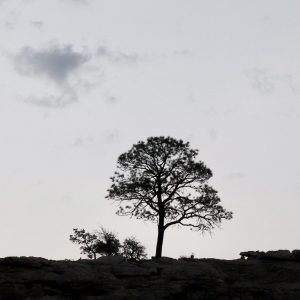
May, 2023. The tree was a sign. A confirmation, maybe. It had been my anchor through several stays at the campground, including my first, buzzing-with-excitement voyage in the van. Every time, it had been the true North my compass turned to every morning, every evening, with every shifting cloud.

In 2023 I barely looked at it for six of the seven days I camped beneath the mesa and huge skies it calls home.

Image shows a gently asymmetrical piñon tree standing sentinel atop a sandstone bluff against a backdrop of cloudless, azure sky. Joe Skeens BLM Campground, Grants, New Mexico, 2023

I once wrote about The Tree—about change and constancy, about identity in different settings. In 2021 the tree had shown me each moment of the natural world in fresh light. In 2023 it showed me myself.

I was tired.

From what I didn’t know. “Run of the mill” illness, just like for the last 27 years? The van? Adventure? I once read, “It doesn’t matter if you think the glass is half full or half empty. If you’ve held it too long, it’s just heavy.” I felt like I had been holding a glass for a long, long time.

I’ve heard, “Nomads are usually running toward something—so by definition we’re also running away from something.” I had run toward family, discovery, community. I had run from entrapment, isolation, emptiness.

Running from chronic problems doesn’t work. 2023 was the year I discovered that the van wasn’t my miracle cure. Illness still emptied most days. I had lost ground.

Was it time to seek a fixed dwelling again? I would have fewer unknowns to master, week after week. Maybe running on autopilot a bit more would lighten the glass.

**************
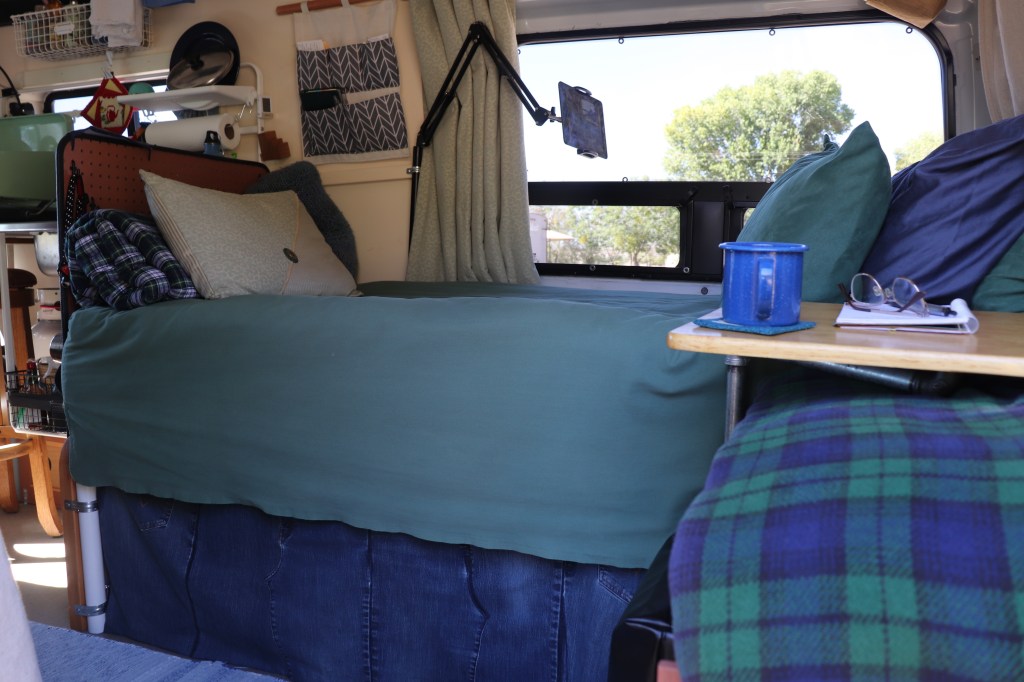
Image shows the living space of my van, complete with cushions, tea mug, and notepad.

I have not been writing. Writing is its own adventure into the unknown. It can be, at any rate: a quest for truth, for the chime of connection, the sympathetic resonances between things that otherwise seem unalike.

I love writing to discover those kinships, listening for the chime and following where it leads. It’s why I struggle with practical prose—how-to posts, top 10 lists, and the marketable niches of “known knowns.” In writing, I love unknowns, and the unknown isn’t practical.

The unknown requires attention, and attention requires energy. It is easier to close off than to open up and listen.

If only that made the unknown go away and stop clamoring. Ready or not, it lies around every corner, every second of every day. It might bring danger, delight or dullness, but it requires response. Energy.

Closing off takes energy, too.

****************

We could die today.

Image shows an elk skeleton amid forest growth. Pike/San Isabel National Forest, Colorado, 2021

That is the heart of the unknown. Do you consider it a downer? Truth is just true. Our response to it—avoidance, denial, fear, control—that might be a downer. Few souls face the unknown fully, freely, lightly, without trying to wrestle it into a safer shape.

****************

I’ve always said that how you cope with the unknown determines how you will cope with chronic illness. When you don’t know whether you’ll be able to cook dinner, meet an obligation, drive safely, or carry on a conversation without ending up in bed for three days, projects and goals become meaningless. Your plans will be derailed. That is a known known. Which ones? When? With what consequences? Will you recover? You have no way of knowing.

My strategy for dealing with that over the years has been to “live within my means”—to reduce the calls on my energy so that I can meet the demands of daily life alone. I thought that meant I was handling unknowns well—I made sure that whatever arose, I had the reserves to handle it. Was I coping well with illness—managing the knowns so the unknowns didn’t broadside me? Or was I denying that unknowns are…unknown and likely to be difficult?

How well do I handle the unknown?

I don’t know…

*****************

April, 2024. I have reduced the parameters again—or so it seems. I have purchased a lifetime lease at an RV park in a community of lovely artists and am acquiring a Tiny Home on Wheels.

I’m excited in a way, and at peace with the choice. Still. Why does this “more” seem like less? Why does stability feel like running? It’s really just practical, as a winter of POTS-related medical problems proved. But it seems like a retreat from adventure back to the cage of being housebound. It feels like a move from life to mere safety.

Long ago I wrote a blog called Microcosm, rooted in the premise that adventure and meaning could be found in the tiniest leaf of a tiny garden. At some point I could no longer find adventure there: the relentless sameness of the known overwhelmed me, even amid moments of beauty.

Image shows a pea pod in the Microcosm garden. It is backlit by sunshine, and the baby peas are silhouetted against the pod. (They are adorable.) A teeny bit of blossom clings to the tip.

That loss wounded my belief in the power of choice—in sheer willpower to find or create meaning in life as it is.

I thought my van could outrun the crushing sameness of a tiny life. Only it couldn’t. Now here I am in southwestern New Mexico, starting again.

What is the difference between emptiness and the unknown?

*******************

Gene picks up, his voice cheerful through tinny reception. “Hi, Stacy!”

He’s overseeing the tiny house build. Neither of us has ever done this, and we have details to hash out.

I’m in the van when claws scrabble on the roof. I have become fairly good at identifying the featherweight hippety-hop of finches and the scratch of Stellar’s jays, but these are new—talons raking for purchase. In another moment, a kestrel lifts off toward the snowy Chiricahua Mountains.

Weeds are sprouting. I don’t know what they are, just that they are forerunners of what will become a habitat garden. I will sow wildflower seeds for spring and fall blooms, as I still want to travel in summer.

I have not outrun all the unknowns here, thank goodness. They still present new possibilities. But the same illness lingers, with the same constrictions. In a slow, grudging way I am becoming perversely intrigued by its lessons not to look elsewhere—not in a tiny garden, not in a van, not in writing—for meaningful days.

I don’t yet know where to look. Occasionally I sense that moments and days might be meaningful without our trying to make something out of them. They might be meaningful just because they’re true. Our efforts to wrestle them into another shape might be the real burden. Need an empty moment be a downer, if it’s just true?

Is adventure anything more than attention?

How long can I pay attention to emptiness?

Caravan

Greg is singing the praises of a beach-side campsite in northern California.

“Ooh, I have to add that to my bucket list,” says Mary Rose, getting out her phone.

(Mary Rose’s bucket list includes the whole world, as far as I can tell. She is spiritedly racing the clock of debility, before spinal stenosis limits her further. She loves every campsite our caravan chooses. All she asks is that we park close enough that she can socialize without having to walk long distances. Even we introverts willingly scoot together.)

When I don’t reach for my phone to make note of this Edenic campsite, Greg cocks a quizzical brow. I explain that I don’t even have a bucket list; I assumed I’d never be able to do anything on it. A realization is slowly dawning.

“I wonder if I’m limiting myself unnecessarily.”

Greg and Mary Rose both smile.

“I’m glad to hear you say that,” Mary Rose says. “I don’t think you’ve fully absorbed the freedom your van can give you.”

Image shows a wintery desert scene in evening light. Tufts of brown growth soften an expanse of gravel. In the background rise two low mountain ranges, the nearer one coppery brown, the farther one more grayish. Near Earp, CA. (The sky is 100% blue in all photos unless otherwise noted.)

“We’re having a campfire tonight. Gwen’s bringing her guitar, and I’ll have mine. Bring your ukulele and play a song for us,” Zeke suggests—again.

“I’m not very good yet.”

Zeke isn’t impressed.

Eventually I gather my courage to play and sing “When You’re Smiling.” Cheers follow.

“Charlie Chaplin wrote that,” says Zeke.

Gwen smiles warmly and talks about how playing in supportive groups encouraged her when she started, too. She launches into a Mazzy Star tune, and the songs keep flowing.

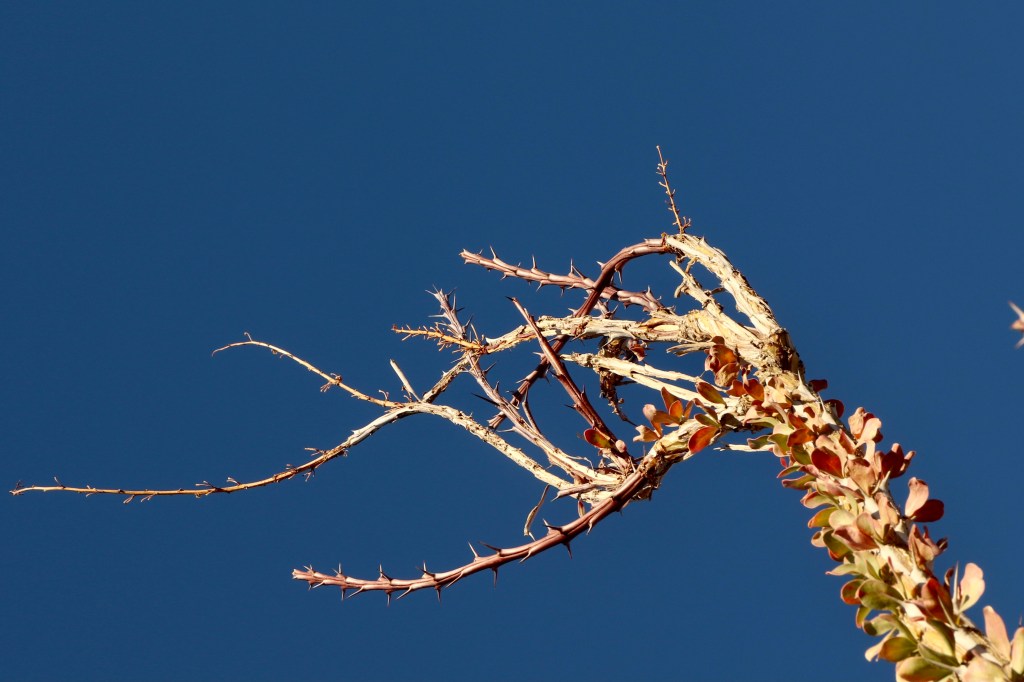
Image shows an ocotillo stem from below, the tiny leaves and not-so-tiny thorns on its twisting branches shining against extraordinarily deep, dark blue sky. At American Girl Mine Road in southern CA.

Evan glances away, his voice gentle. “I know you’re not able to hike, but you miss exploring. Is there a reason you don’t break camp to explore by van?”

Oh. There isn’t. I realize that I’ve been conditioned by camping alone in Colorado over the summer not to leave a campsite lest I lose it. Now I have fellow campers who are glad to save my place.

Image shows a dust storm beginning at American Girl Mine. In the background, layers of charcoal and gray mountains shimmer through a fine layer of blowing sand. In the foreground, creosote bush shows bright green against a ground of gray gravel.

“I’m stuck in deep sand. Can you pull me out?”

“On my way,” Zeke texts back. While I wait, I make a cup of tea and relax in desert sunshine with my ukulele. Soon Zeke shows up and unearths a snatch strap from his arsenal of recovery gear. He’s perfectly cheerful about having to break camp and wallow in sand under my van to attach the strap to the front axle. In moments I’m mobile again.

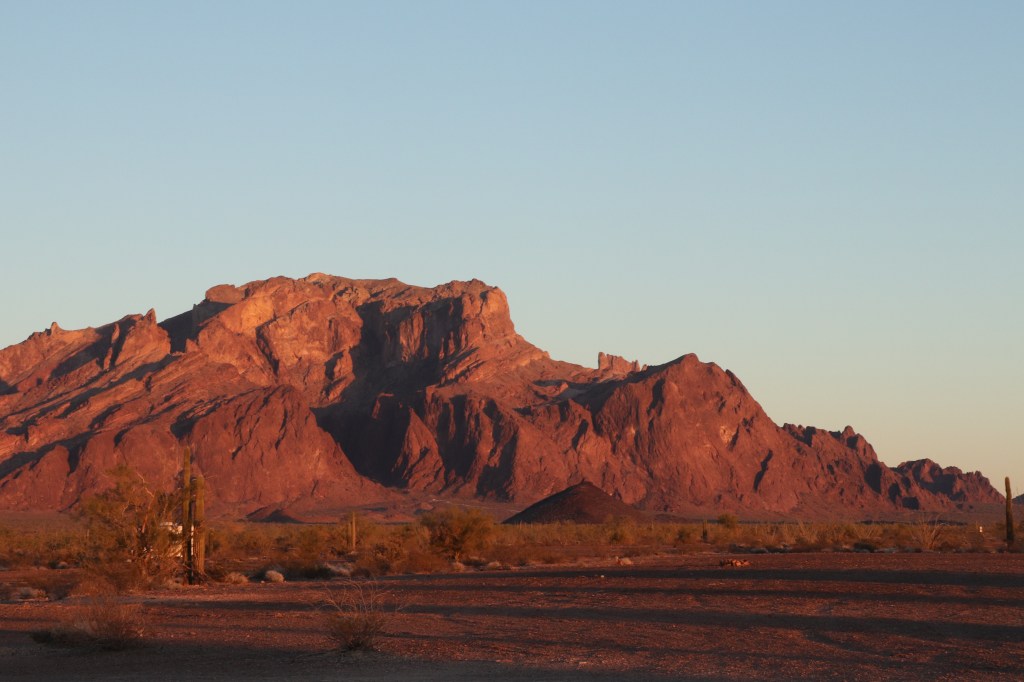
Image shows evening sun bringing warmth to a giant mountain shaped like an iceberg. At Kofa National Wildlife Refuge, AZ.

“I may have to leave,” I tell Tess. I’m not used to socializing. I haven’t conversed with five people at once in years. I struggle to process all the information in a conversation. And people keep dropping by my van to chat, as if they want my company. My brain is fried, and I’m exhausted, unable to recover after a flare-up without full rest.

“No, don’t leave!” she replies in dismay. “We’ll find a way to make it work. You can put up a flag or something when you’re up for company. Just please stay.”

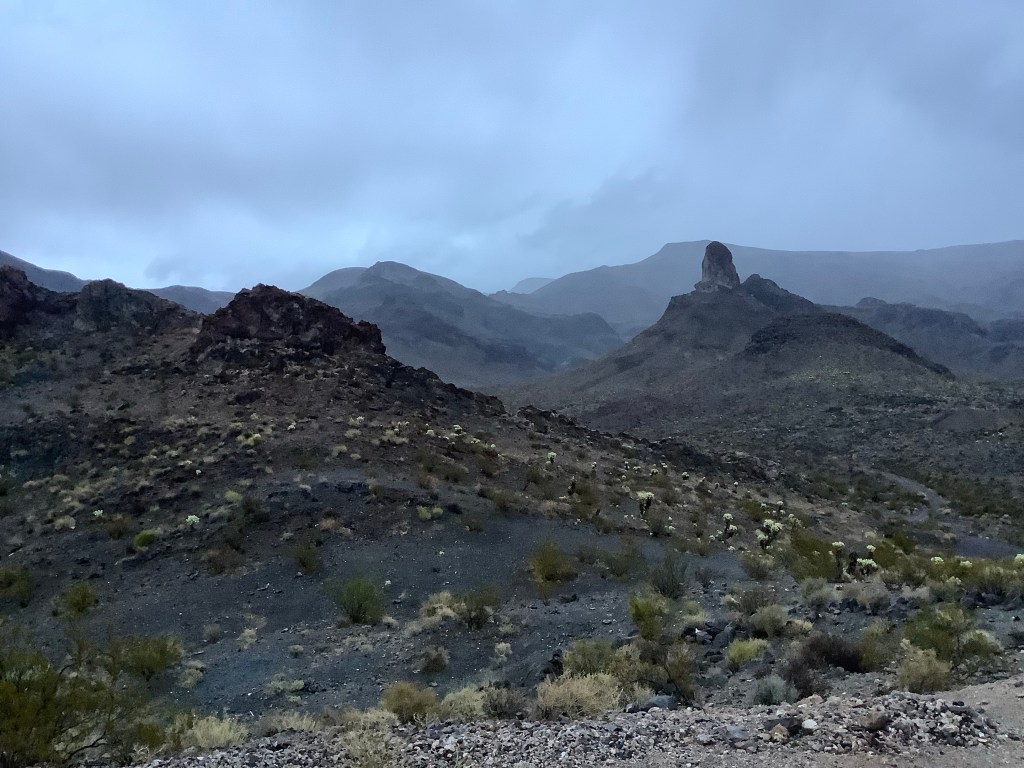
Image shows fog, of all things, on a dramatic, cloudy morning amid the mountains and spires of Oatman, AZ. The foreground is dotted with white “jumping” cholla—extra-spiny cacti that pounce on the wary and unwary alike.

Just please stay.

Except among my inner circle of family and friends I have never encountered people who accepted my disability so readily, with so little judgment; who encouraged me to stretch my limits without denying them; who accommodated them with so little resentment. Not once in the 4 1/2 months I camped with this shifting constellation of people did I feel pressured to “pass” for able-bodied.

My experience in 26 years of illness, including six of disability, is that most people are willing to accommodate limits—right up until the moment those limits affect them. That’s when you become a whiner, an oddball, a wuss; someone without the gumption or will or character to keep up. The disabled, neuro-atypical, ill, or elderly who want full access to a world built for others are not always considered fully fellow humans, but rather an irritating, “less-than” minority making inconvenient demands of the “real” people. We may be accommodated out of pity or under duress, but seldom because we’re desired. Because people want our company.

I have often found it easier to harm myself by trying to “pass” in public for abled or to withdraw from the world of the (temporarily) able-bodied than to be thus diminished. The fight for self-hood can feel like the ultimate exercise in futility, because people who don’t see you as “real”…don’t see you.

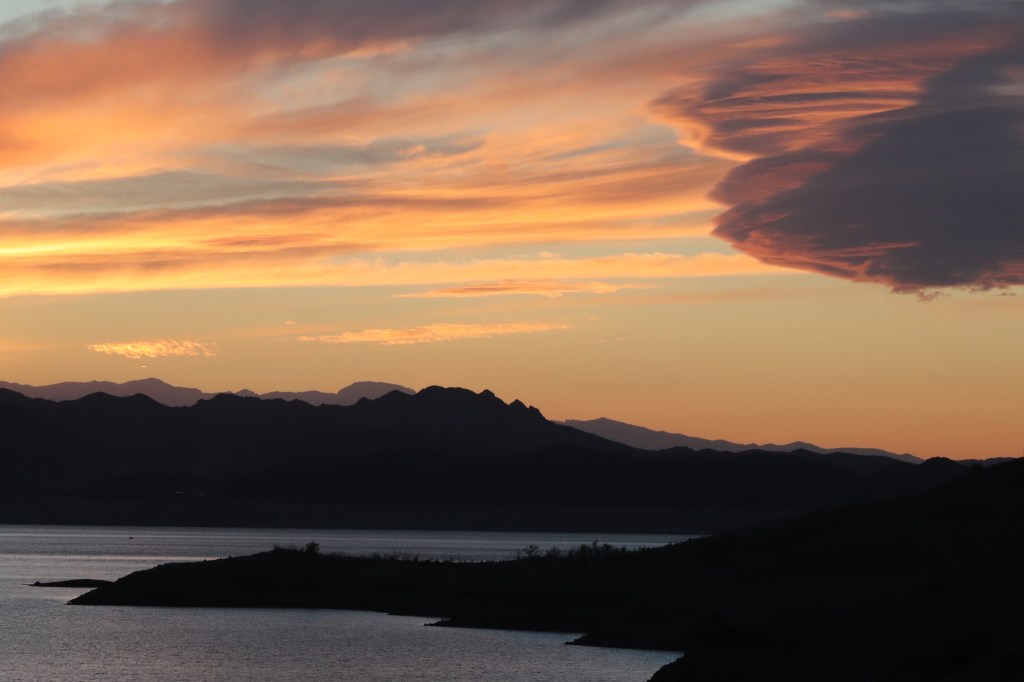
Image shows the sunset over Lake Mead. A lenticular (“spaceship”) cloud dominates the upper right sky; to the left are streaks of more ordinary, sorbet-colored clouds. In the foreground, the mountains are layered in midnight and paler blue, with the lake lapping at their feet.

“Just please stay.”

One member of our caravan has hiked the Appalachian Trail; one was a wildland firefighter. One ran ultra-marathons, another served in the Navy for twenty years. One walked across America and rode the rails as a hobo for fun. One raised a child at 16. These are not people who twiddle their thumbs.

What grace made them open to limitations, taught them to understand human value as separate from ability? To care more about the “content of someone’s character” than their capacity to perform up to standard?

Why did they value me enough to accommodate my disability when others have not, even though I have been the same person to them all? Are nomads—people for whom “So, do you have a sink?” is a genuine, curious question—just predisposed to see a broader range of normal?

I don’t know. We certainly had our share of -isms, judgments, and divisions. I just know that in this caravan, ableism wasn’t one of them.

It matters, more than I can tell you, to belong.

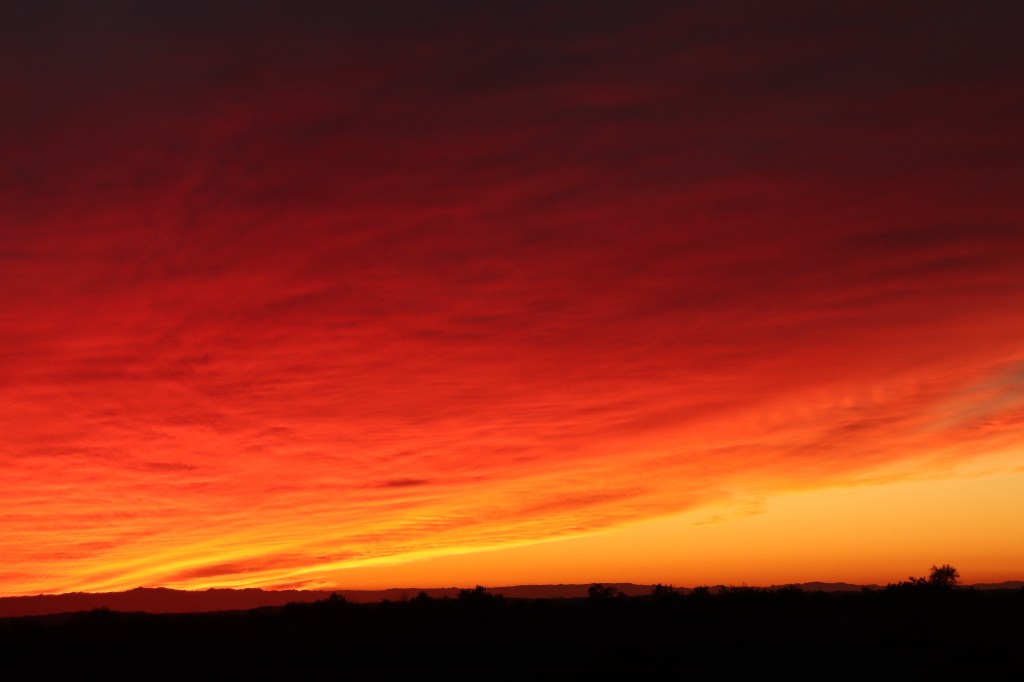
Image shows a dramatic sunset at American Girl Mine. A single cloud, shaded from neon orange below to almost black at the top, angles upward across the whole photo. The sky at the flat, black horizon glows hot.

*****************

I encountered my caravan through the Homes on Wheels Alliance. HOWA is a not-for-profit that prevents unsheltered homelessness and supports nomadic communities. Every winter they organize caravans in the desert southwest. I joined one simply hoping for a sense of safety. I certainly found a great deal more than that.