In search of a new identity.

Fourteen fragments of truth—puzzle pieces, potsherds:
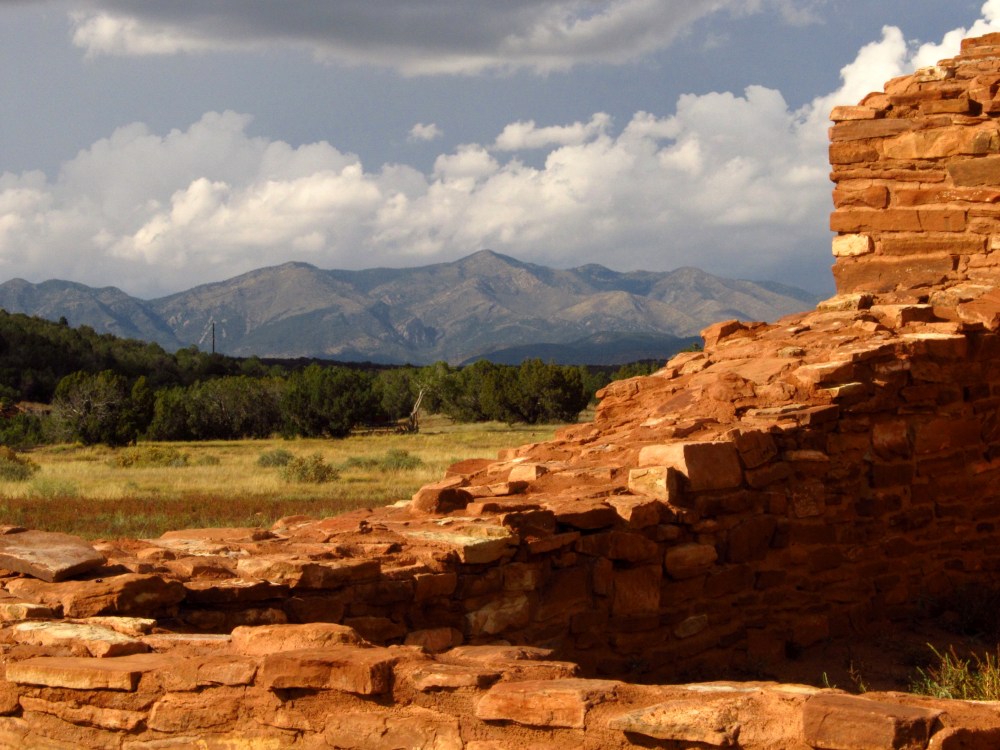
1. Northwest from Albuquerque, beyond the box stores of exurbia, up through scrub desert where piñon and juniper grow, past sandstone mesas, Dust Bowl ruins and faded Trading Post signs, amid mile after mile of sagebrush, is the corner of the Navajo nation where New Mexico, Arizona, Utah, and Colorado meet. Their borders touch at 90° angles—square dancers reaching a hand into the center of the dance.
If you’re not from one of the four states, you might not notice much difference between them; sagebrush all looks alike. You might regard the Four Corners as an oddity—its arbitrary lines are a thing to see, and so you have seen them. Bucket list item, check.
If you live in the Navajo nation, your experience of the Four Corners may include inconvenience, as you deal with overlapping tribal administration and state systems. It may be a wound—the fragmenting of your culture by the federal government. The very arbitrariness of the lines makes an impact.
If you live elsewhere in the four states, the sense of threshold might be more marked. Each state has its own character: Arizona’s prickly-heat politics; New Mexico’s cheerful tolerance and deep poverty; Colorado’s comparative plenty; Utah’s Mormonism and countercultures. For me, to stand at the Four Corners in both my homes of Colorado and New Mexico is a satisfaction. To step across into Arizona or Utah is an adventure. The lines are arbitrary and bureaucratic, but they are also cultural, personal. They create allegiances.
That is the power of lines. From one square foot to another, your identity changes.

2. Carl Philipp Emanuel Bach, son of Johann Sebastian, enjoyed a long career as the court composer of Prussia’s Frederick the Great. His music combines traits of his father’s, new features that later composers like Mozart and Haydn would borrow freely, and other sounds all his own. It is theatrical, rhetorical, and idiosyncratic, known variously as Rococo, Sensitive Style, and Storm and Stress. Since it overlapped the Baroque and Classical eras we label it “transitional.”
But C.P.E. Bach didn’t write to be transitional: he didn’t know the future. He wrote music that spoke to his contemporaries. It is we who have looked back and sorted 18th-century music into categories: Baroque, Classical, and Other. The styles which are neither fish nor fowl get filtered out of our awareness.
Does that reflect the music’s value? Its craft and capacity to move? Or does it reflect our preference for strong filters that group things neatly together? Is it a statement of truth, or an arbitrary line?
When you are neither fish nor fowl, you risk being nothing. A quaint oddity, and no more.

3. “Which of these things belong together? Which of these things just doesn’t belong?”
How many times did I hear that Sesame Street song when I was little? I can still see the TV screen divided into quadrants. Three squares show similar items—kinds of animals, say—and one a dissimilar. Young viewers learn what qualities create likeness. Grouping is a useful skill. But we do learn early that difference doesn’t belong.
4. My alma mater, New College of Florida, takes a non-traditional approach to education. It attracts many students who were misfits in high school. An alumnae/i Facebook page resounds with the stories: “I found my tribe at New College. I felt like I belonged.”
As I recall, some of those who “found their tribe” celebrated their new kinships with a vengeance; they became deeply tribal. Students who were not hippies, goths, or punks—visibly countercultural—could be left out once again. From the sidelines they watched the mechanism of alienation at work anew. The ones who did not find a tribe became the most deeply tolerant people I’ve ever met.
5. A coffee shop addict in the days before Starbucks, I used to think the universe had only one Barista, cloned many times. The Barista wore dreadlocks and nose rings, black indie-band T-shirts, and ripped jeans or a peasant skirt. The counterculture has its own ways of pledging allegiance, just like the mainstream. Same mechanism, different dress code.
Unique snowflakes last longer in a snowstorm than in a jungle.

6. Then-presidential candidate Mitt Romney, 2012: “[T]here are 47 percent who are with [the president], who are dependent upon government, […] who believe that they are entitled to health care, to food, to housing, to you-name-it. […] Our message of low taxes doesn’t connect…so my job is is not to worry about those people. I’ll never convince them that they should take personal responsibility and care for their lives.”
Then-presidential candidate Barack Obama, 2008: “Our challenge is to get people persuaded that we can make progress when there’s not evidence of that in their daily lives. You go into some of these small towns in Pennsylvania, and the jobs have been gone now for 25 years and nothing’s replaced ’em. […] So it’s not surprising that they get bitter, they cling to their guns or religion or antipathy toward people who aren’t like them or anti-immigrant sentiment or anti-trade sentiment as a way to explain their frustrations.” [edited for brevity]
Makers and takers; guns and religion. They’re both shorthand for Not Like Us. Romney wrote Them off altogether; Obama paid lip-service to engagement. But once you’ve drawn lines of difference, few will cross them.
7. The fun of a mystery novel—or a romance or fantasy—isn’t usually finding out what happens. It’s seeing how authors play with the framework and fill it with something unusual. Genre fiction creates a tidy set of expectations. Since we know what to expect, difference—even subversion—is welcome.
The “genres” of group identity create expectations about behavior, but they also make protest and subversion possible. Kicking off from the side of a swimming pool is easier than gaining momentum in open water. Frameworks provide something to resist.

8. A friend from Israel never thought of herself as keeping kosher until she moved to the United States. Then she realized that she had kept kosher, simply because everything in Israel was kosher. The norm doesn’t feel like identity—it’s just life.
9. Who are you? How do you identify, and why? Tell me about yourself.
10. Advice for beginning bloggers often says: Choose your niche. Are you a garden blogger, a mommy blogger, a tech blogger? Seek out others like you, and you will build readership more easily. Preach to the choir, and you are more likely to be heard.
Be an individual, but an individual in a genre. Otherwise you will be alone. A quaint oddity, and no more.

11. William Penn was born to middle-class British society in the 17th century, when men of fashion wore dress swords. Penn became a Quaker, and he wasn’t sure whether he should still wear his sword. He asked George Fox, the Society’s founder, what to do.
Fox said, “Wear it for as long as you can.”
That story may not be true—it was first written down a century later. But that we tell it often—and that it was written at all, and became part of our lore—says a lot about what we want to be true. The story tipped me toward Quakerism. I didn’t know religion could do that: recognize so deeply that we live out faith in a journey, not a pretense of arrival; that the journey deserves respect; that adherents’ integrity—their openness to change at the right time—could be trusted. I didn’t know that a religion could value authenticity over conformity.
The next time Fox saw Penn, Penn didn’t have his sword. He said, “I wore it for as long as I could.”
12. You may not be fascinated by trends in 1990’s musicology, but I’m here to tell you that “ambiguity” was a big word at the time. My fellow graduate students and I would parse the music of Stravinsky or Schumann to debate whether a gesture hearkened back to measure x or forward to measure y. We pored over relationships in the score. Eventually we might proclaim, “It’s ambiguous.” We reveled in our postmodern ability to embrace multiple meanings.
One professor excelled at bursting bubbles. “On paper you see two meanings. But performers don’t have that luxury—they have to choose one or the other. In practice, ambiguity isn’t possible.”
13. If it walks like a duck and talks like a duck…

But ducks don’t choose. They’re just ducks.
14. Quakers don’t have creeds; instead we have “testimonies” to the Light. The best-known is peace, but the others are simplicity, integrity, community, and equality. Sets of questions encourage Friends to explore how they might live out the testimonies.
One meeting’s Query: “Do I refuse to let the prevailing culture and media dictate my needs and values?”
_____________________
Assembling the fragments:
When did I become someone who writes about illness? I miss Microcosm‘s gentle essays on gardens. Other occupations dwindled when the demands of illness grew.
But is this who I want to be? Is Chronic Illness now my primary identity?
I wonder about this—the difference between a slow slide toward a new self and a choice I can make—as I wonder what it means to be on disability. I didn’t choose illness, and my inner person still hikes and travels and loves live music and provides for herself, even though my outer person mostly lies on sofas. In my head I can see both my personality and my actions and accept the difference between them. I can believe in my old self despite illness; I can embrace the ambiguity between theory and practice. But to say who I am, in that performance, I have to choose. If it walks like a duck… My choices and actions call kin with disability. I do not belong in the tribe of the healthy.

When strangers ask me what I do, though, I hesitate to say, “I’m disabled.” It’s such a small way to define a life. (Paradoxically, it also seems like too big a burden to lay on a stranger. But why, when I was asked?)
The “elevator speech” is the ultimate identity marker: it distills a life to a few words. Its shorthand tells only a partial truth, and we all know that. But the information we expect to hear speaks loudly about which genres of truth we honor.
We do not expect elevator speeches to be about our favorite vegetables or best-loved authors—or, heaven forbid, our deepest values. We expect them to be about work. We honor those who are physically strong and neurally typical enough to work a paying job. Work signals both self-sufficiency and normalcy.
Asking “What do you do?” is a generic ice-breaker. But its subtext is, “How are you one of Us?” Awkwardness covers the moment you come out as a Them. (Retirees and Stay-at-Home Moms strike me as Honorary Us-es—I’d be interested to know if that’s true.)
Working was certainly part of my self-image—I knew it was Me—but I didn’t fully realize how much it made me an Us until I became a Them. I didn’t think of the Tribe of the Working as my identity—it was just normal, just life. Now a new box gets checked on my tax forms: I have membership in a different tribe. Do I claim that identity?
I dislike labels. I distrust the way they divide the truths we are willing to hear into ever smaller pieces. I distrust the way individuals defend the partial truths of group identity as if they were complete. I do not care for tribal thinking, which values allegiance over kindness. I am okay with being “maladaptive to dysfunctional culture and oppression.” For the last few years I have been willing to be a quaint oddity, claiming no (conscious) tribe, fitting nowhere. I wore that sword for as long as I could.
But I also find myself thinking about belonging, and the Friends’ testimony of community: the idea that we lovingly pool our partial truths and so come closer to the whole.

All labels—all—all partial truths—make it easy to forget the full humanity of those who wear them. Even so, I will claim the labels of Disabled and Chronically Ill, simply because I do not permit others to define them for me. “Taker.” “47%.” (The other common view, that the disabled are “inspirations” for the able, isn’t much more humanizing.) I am more complex than that—all those I know are infinitely more complex than that—and I claim the labels so that I can add my truth to their definition.
More precisely, I claim participation in overlapping communities, including the Quakers, Disabled, and Chronically Ill. My elevator speech is not about identity, with its own new ego boundaries to maintain, but about these communities where I contribute my partial truths. (It is a long speech.) Disability, or any vulnerability—any difference from the norm—sometimes brings out the worst in our culture. I find it important to call out those impulses, and these three communities give me a sturdy framework for protest.
Of course, this blog is a community as well. You are my community. I write from the standpoint of illness because it is the partial truth I have to contribute here. The issues affecting the chronically ill are not unique to us. Belonging and alienation, identity, hope and resilience—our communities all intersect with them in different ways. So illness is not what this blog is about, any more than Microcosm was really about gardens. It is a starting point.
This is a starting point.




 The Stories of Trees